LangstonePrimary Academy
Science
Intent
All planning should be driven by the aims:
-
To provide the foundations to understand, question and explain the world around them.
-
To provide children with memorable experiences that enrich their lives, generating a sense of excitement and curiosity about natural phenomena.
-
To have the understanding of different scientific enquiries to enable them to answer specific scientific questions as well as their own.
In order to achieve this, we will:
-
Promote learning through awe and wonder so they question the world around them. Because our children learn best when inspired and when they can see a ‘real purpose’ to what they are learning. This will encourage thinking and enable them to raise their own questions.
-
Provide opportunities for practical enquiries, where children can apply their new scientific knowledge to real-life examples. Because we want to encourage independent learners who have the skills to be able to ask their own questions.
-
We develop children’s explicit scientific knowledge and conceptual understanding. Because this will ensure children have a rich foundation of science allowing them to discuss and deepen their understanding further whilst making links to their prior learning.
By the end of EYFS, children will:
-
Explore the natural world around them, making observations and drawing pictures of animals and plants.
-
Know some similarities and differences between the natural world around them and contrasting environments, drawing on their experiences and what has been read in class.
-
Understand some important processes and changes in the natural world around them, including the seasons and changing states of matter.
-
Safely use and explore a variety of materials, tools and techniques, (experimenting with colour, design, texture, form and function.)
By the end of KS1, children will learn the skills of science through:
-
Biology:
-
Name and classify animals, including humans
-
Observe seasonal changes, develop understanding of what plants need to germinate, grow and survive
-
Simple reproduction of animals, moving on to their basic needs and importance of a healthy exercise and hygiene.
-
Find out about living things and their habitats
-
Chemistry:
-
Sort and classify the properties of materials
-
Develop their knowledge of materials – what are particular materials suitable for and what properties do different materials have?
By the end of KS2, children will:
-
Know how to raise questions about working scientifically and take the initiative in planning and carrying out scientific investigations in a variety of contexts.
-
Understand how to report scientific findings with both verbal and written explanations
-
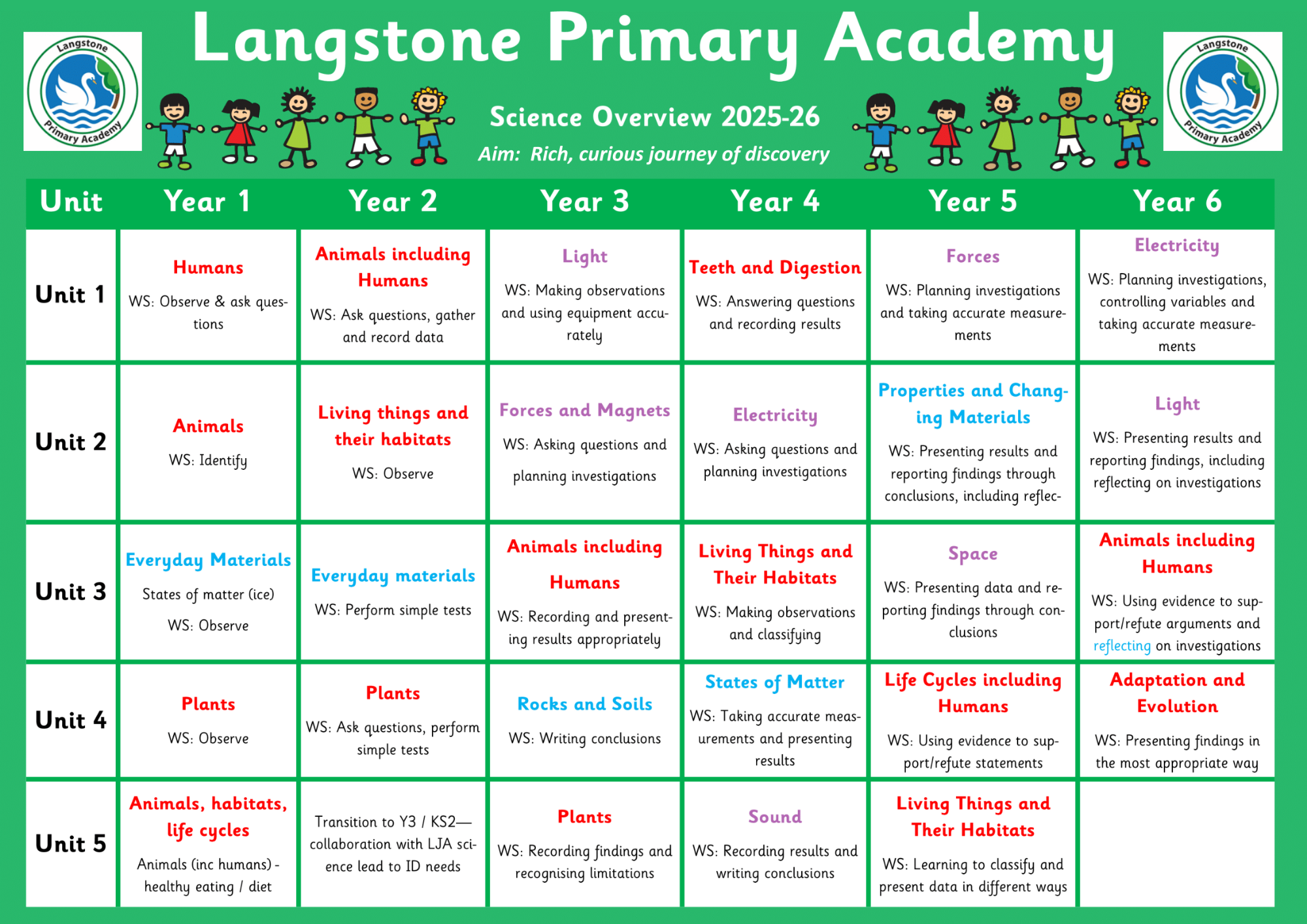
Gain an understanding of substantive knowledge in the following parts of science:
- Biology:
- Living things and their habitats
- Human and plant anatomy and physiology. Children will use this knowledge to help them deepen their understanding of Biology through our ‘Evolution’ unit in Year 6
- Chemistry:
-
Rocks and soils,
-
Properties and changing materials, including states of matter.
- Physics:
-
Types of everyday materials,
-
Forces, including magnetic,
-
Light
-
Sound
-
Electricity
-
Outer-space